Why Most M&A Deals Fail: The Human Capital Blind Spot

Share

Badr Ait Ahmed

January 16, 2026

Since 2000, companies have spent more than $57 trillion on mergers and acquisitions. That figure represents the largest sustained transfer of corporate value in business history. At this scale, even small execution failures compound into systemic value destruction.

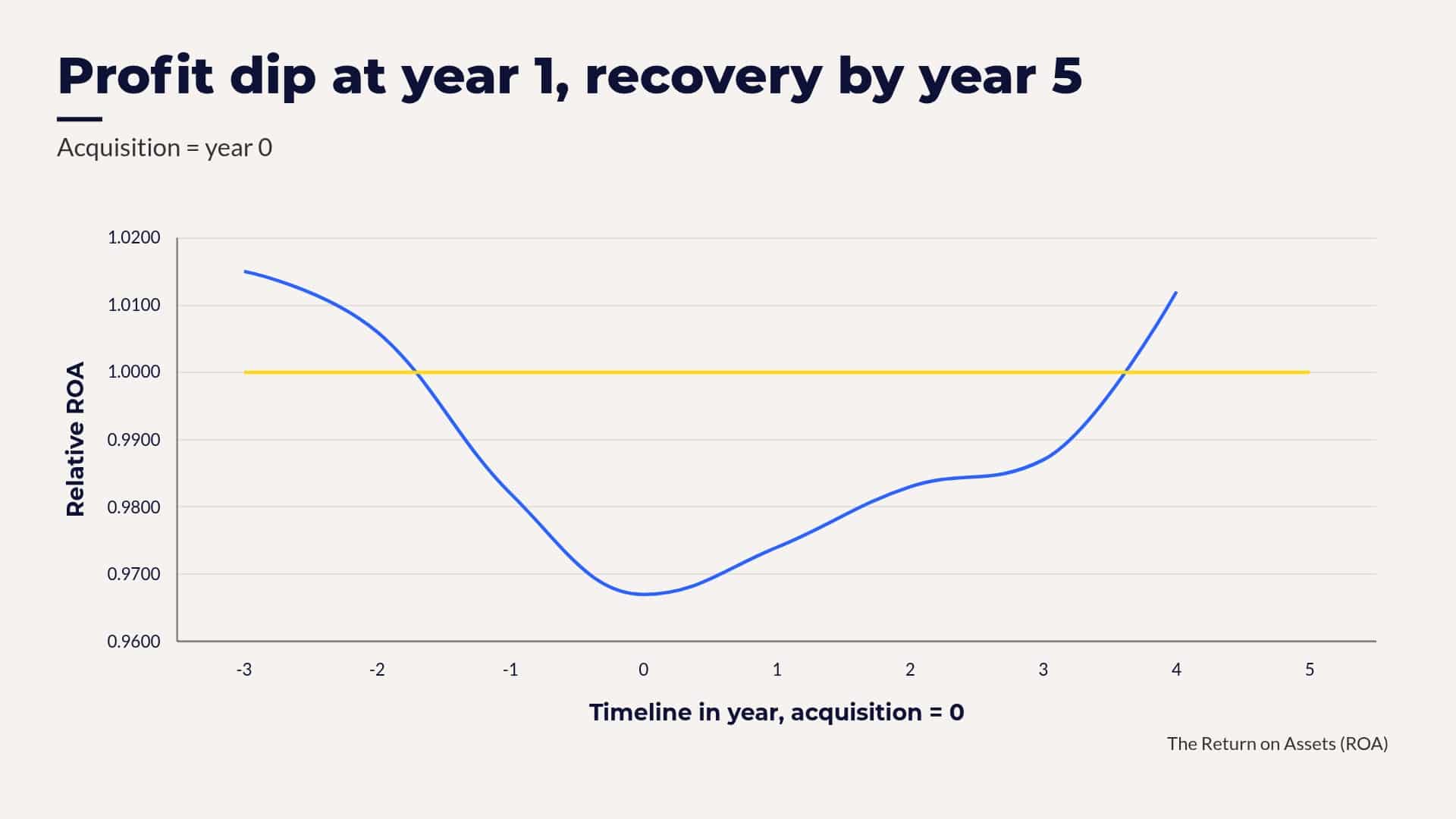
Yet research across industries places the failure rate between 70% and 90%.

The pattern is consistent: deals are announced with compelling strategic narratives, valuations are justified with detailed synergy models, and integration teams mobilize with carefully constructed playbooks. Then value erodes anyway.

The question is not whether most deals fail. The question is why, and what separates the minority that succeeds.

The Catastrophic Cost of Getting It Wrong

The scale of value destruction in failed M&A is difficult to comprehend.

Bayer-Monsanto (2018): A $63 billion acquisition that wiped out more than $50 billion in shareholder value. Beyond legal liabilities, leadership instability and cultural incompatibility slowed decision-making and eroded execution capacity during integration.

GE-Alstom (2015): A $10 billion purchase that led to a $22 billion impairment three years later. Strategic misreading was compounded by internal capability gaps to pivot execution as market conditions shifted. The CEO later admitted publicly that he would not have done the deal.

Kraft-Heinz (2015): A merger that resulted in $28 billion in write-downs. Aggressive cost synergies ignored organizational resilience and long-term talent sustainability. Warren Buffett stated bluntly: “We overpaid for Kraft.”

These are not edge cases. They are representative outcomes. Behind every headline-grabbing failure are dozens of smaller deals that quietly destroyed value, depleted leadership teams, and derailed strategic momentum.

The Hidden Culprit: What Due Diligence Misses

When analysts dissect failed deals, the usual suspects emerge: overpayment, integration failures, cultural clashes, and key talent departures. But these are symptoms, not root causes.

The root cause is simple: execution risk is assumed away rather than measured.

Traditional due diligence excels at quantifying financial assets, legal liabilities, and operational metrics. It falls short — often catastrophically — in assessing what actually determines post-close success: the people who must execute the combined strategy.

Consider the data:

  • Three in four CEOs are replaced following an acquisition
  • 54% of those departures are unplanned
  • Critical talent flight typically spikes in months 3-12 post-close
  • Cultural friction costs remain largely unquantified until they manifest as attrition, productivity collapse, or integration paralysis

These are not integration issues. They are diligence failures.

These human capital factors are rarely modelled with the same rigour applied to EBITDA multiples or working capital adjustments. Yet they determine whether synergies are captured or evaporate.

Where Deals Actually Break: The Six-Stage Model

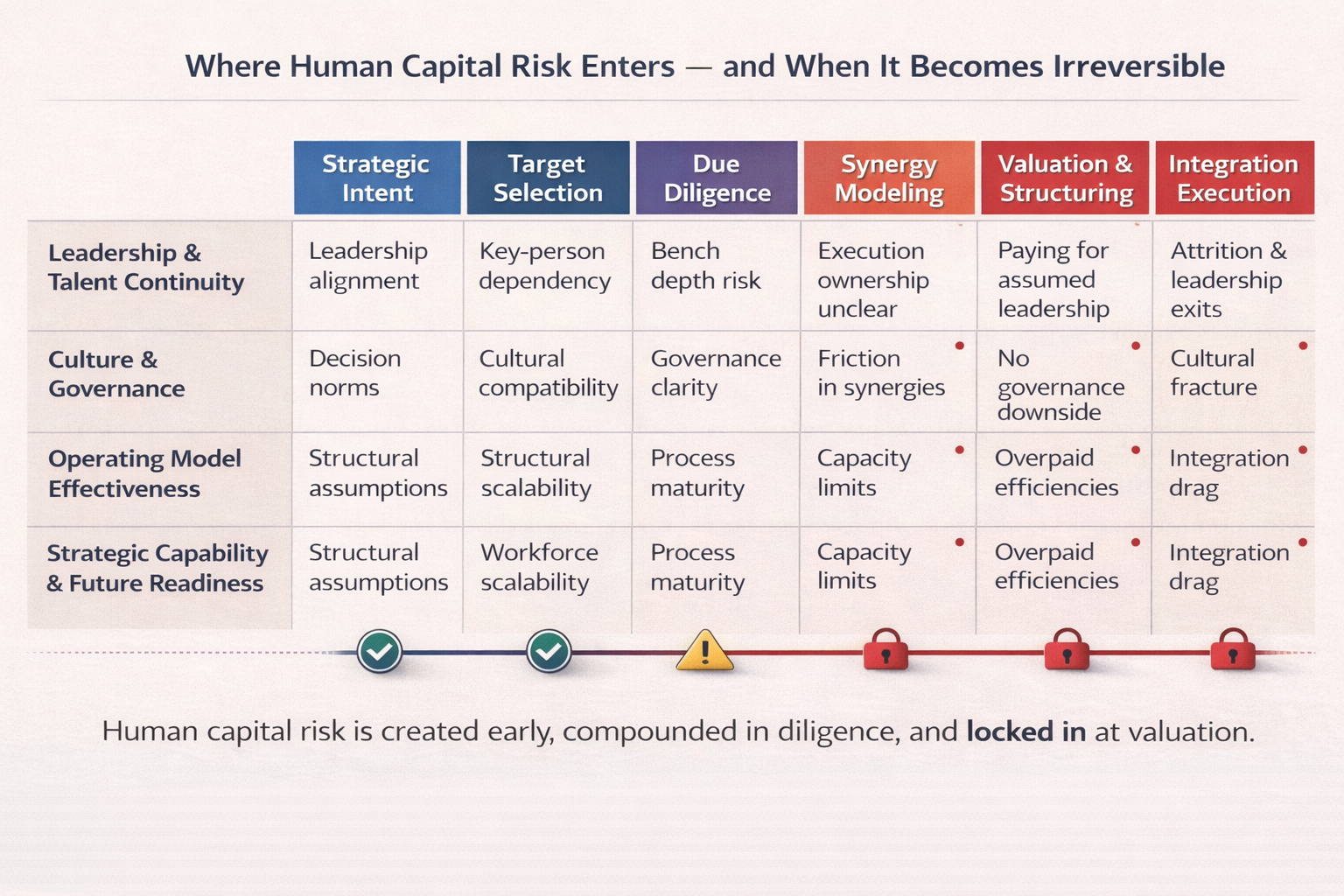
Research by Feldman and Chunduru identifies six distinct stages where M&A success or failure is determined. What emerges is a clear pattern: the seeds of failure are planted long before Day One.

Stage 1 — Strategic Mode Selection: Is M&A the right tool? Many deals fail because the acquisition was a reflexive response rather than a validated strategic choice.

Stage 2 — Target Identification: Is this the right company? Over-indexing on financials while under-indexing on capabilities, culture, and workforce fit is a common error.

Stage 3 — Due Diligence: This is where most failures originate. Treating diligence as a checklist rather than a risk model creates blind spots in leadership quality, execution readiness, and cultural compatibility.

Stage 4 — Synergy Evaluation: Synergies drive valuation but are routinely overstated, double-counted, or unrealistic. Growth synergies are especially prone to optimism bias.

Stage 5 — Valuation and Deal Structuring: Paying for synergies not yet proven locks in losses that cannot be recovered through integration excellence.

Stage 6 — Integration Planning and Execution: By this stage, the outcome is largely determined. If integration starts after Day One, value is already leaking.

Human capital risk compounds across stages — it is rarely created in isolation and rarely fixed downstream.

The critical insight: The success of an M&A deal is determined long before integration begins. Weak strategy, inadequate diligence, inflated synergies, and overpayment cannot be fixed by world-class integration teams.

What Strong Acquirers Do Differently

The minority of acquirers who consistently capture M&A value share common practices that address the human capital blind spot directly:

They quantify execution readiness. Can the combined organization actually deliver what the deal model assumes? This question requires rigorous assessment of leadership capacity, organizational design, and workforce capability — and it is the most differentiating practice among successful acquirers.

They integrate human capital into the deal thesis from day one. Leadership assessment, cultural due diligence, and talent risk analysis are not afterthoughts — they inform target selection, valuation, and integration design.

They conduct exploratory diligence, not just confirmatory diligence. Rather than seeking evidence that supports the deal rationale, they actively search for value blockers and quantify their impact.

They protect critical roles and high-impact teams. Before closing, they identify the 5-10% of roles that drive 90% of value creation and design retention strategies accordingly.

They begin integration planning during diligence. The future operating model, leadership structure, and cultural integration approach are defined before the deal closes, not improvised afterward.

The Path Forward: Making Human Capital Measurable

The solution to the human capital blind spot is not more intuition or better judgment. It is a systematic measurement.

The highest-performing acquirers have moved toward data-driven human capital assessment that parallels the rigour applied to financial due diligence. They score leadership bench strength, quantify cultural alignment gaps, model talent retention risk, and stress-test synergy assumptions against execution capacity constraints.

For example, modelling a 15% attrition risk in revenue-critical roles often erases projected growth synergies. Without this calculation, deal models assume execution that will never materialize.

This approach transforms human capital from a vague risk factor into a measurable input that shapes deal terms, integration priorities, and value creation roadmaps.

The 70-90% failure rate is not inevitable. It reflects a correctable gap between how deals are evaluated and what actually determines their success.

The question for any acquirer contemplating their next transaction: Do you know your human capital score? Or are you still assuming execution will take care of itself?

The Human Capital Score framework provides a systematic assessment of four core pillars — Leadership & Talent Continuity, Culture & Governance, Operating Model Effectiveness, and Strategic Capability & Future Readiness. [Contact us] to discuss how data-driven human capital due diligence can protect your next transaction.

Related resources

Share   Badr Ait Ahmed Revenue synergies are modelled on a basis-point basis. Human capital risk is assessed with an interview guide. That is not

Read More »

Share   Badr Ait Ahmed 60 to 70 percent of your operating cost is people. You optimize procurement with vendor scorecards. Marketing with attribution models.
Read More »

Share   Badr Ait Ahmed The U.S. military figured out strategic workforce planning in the 1970s. Most Fortune 500 companies still haven’t. Hidden in defence

Read More »

Share   Badr Ait Ahmed “Culture fit” might be the most dangerous phrase in M&A. Nearly every executive claims cultural alignment matters—yet the data tells

Read More »

Share   Badr Ait Ahmed Why Automating the Back Office Won’t Transform the Business—and Why Most AI Projects Fail Trying The Efficiency Obsession In boardrooms

Read More »

Share   Badr Ait Ahmed Since 2000, companies have spent more than $57 trillion on mergers and acquisitions. That figure represents the largest sustained transfer of

Read More »