From Risk to Leverage: Why Human Capital Readiness is a Seller’s Hidden Deal Advantage

Share

Badr Ait Ahmed

October 1, 2025

From Risk to Leverage: Why Human Capital Readiness is a Seller’s Hidden Deal Advantage

In every M&A transaction, due diligence is an exposure exercise. Buyers dig — as they should — into liabilities, risks, and vulnerabilities that could erode the value they’re about to acquire.

Most sellers prepare their numbers. They tidy up their contracts. They project confidence in operations. But few prepare with the same discipline when it comes to human capital — the very layer of the business that can derail a deal, delay closing, or deflate valuation.

The irony is sharp: talent is often the most critical asset in a business — and yet it’s the least visible in traditional due diligence preparation.

This is where forward-looking sellers can turn a blind spot into a competitive edge.

The Blind Spot: Human Capital Risk Isn’t Always on the Spreadsheet

Buyers today go far beyond balance sheets. They’re asking:

  • How stable is the leadership team?
  • What institutional knowledge is lost when one person exits?
  • Are there workforce compliance risks lurking under the surface?
  • Are the systems (HR, payroll, benefits) transferable or entangled?
  • What happens on Day One if no support is in place?

These questions, if unanswered, raise perceived risk, delay closing, or justify last-minute price reductions. Worse, they narrow the buyer pool to only the most experienced and risk-tolerant investors.

Buyers today are cautious, and human capital uncertainty triggers caution.

What is a TSA

A Transition Services Agreement (TSA) is a temporary arrangement where the seller continues providing selected services, IT, finance, HR, payroll, etc., for a limited time post-close.

What Sellers Can Do: Prepare Like a Partner, Not Just a Counterparty

Sellers who shift their mindset — from passive respondent to proactive partner — create a very different impression.

By preparing structured responses to human capital due diligence, and by offering clear Transition Services Agreements (TSAs) in areas like payroll, IT, HR, and operations, sellers signal more than cooperation:

They signal credibility, stability, and confidence in the asset.

And in turn, they unlock deal benefits that go beyond smooth execution.

Why a TSA is a Strategic Lever, Not an Operational Burden

It’s understandable why some sellers resist TSAs. They want a clean break. They don’t want to tie up people or systems in a business they’ve sold.

But that resistance often backfires.

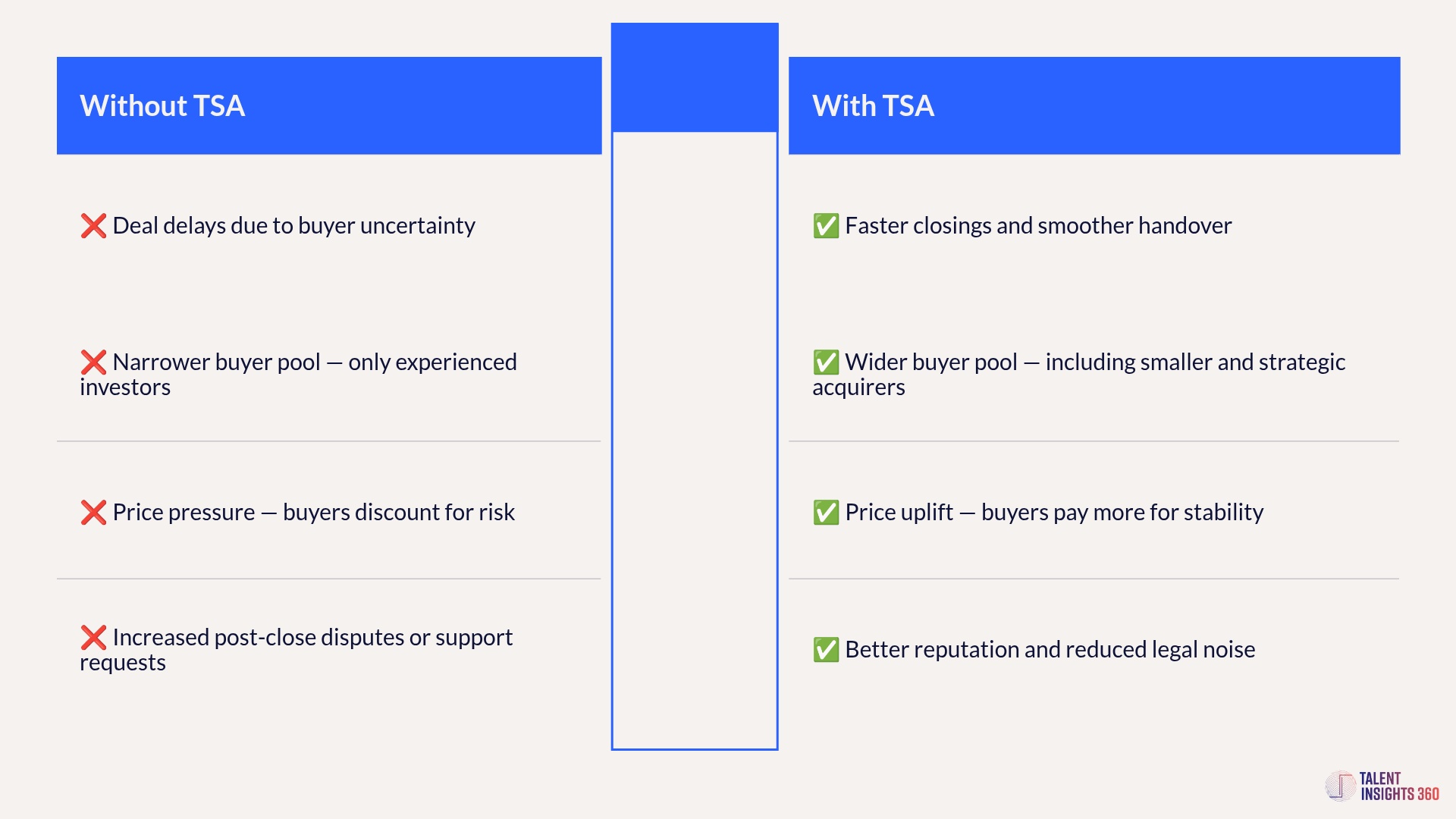
Here’s what the data and deal outcomes show:

A well-scoped TSA doesn’t need to be open-ended or burdensome. It can be short-term, precisely defined, and priced accordingly. What it does is offer the buyer a bridge — and in doing so, it increases trust, speed, and valuation.

De-Risking the Deal Starts Before the Deal

The best time for sellers to prepare is before the buyer begins asking. A few practical steps:

  • Map key dependencies: Who holds critical knowledge? Are there any single points of failure?
  • Assess systems handover: Which HR/payroll/IT systems are shared? Can access be transferred or continued temporarily?
  • Identify cultural or leadership risks: Are there retention concerns? Would a sudden departure create instability?
  • Design a lean TSA playbook: Offer clarity — what services can be provided, for how long, and at what cost?


This level of preparation answers questions before they become objections.

It transforms the seller’s position: not just someone offloading an asset, but a partner presenting a de-risked, investment-ready opportunity.

Why It Matters More Than Ever

In today’s environment — with more deals competing for fewer premium buyers — sellers need every advantage.

A well-prepared seller:

  • Attracts a broader buyer pool
  • Accelerates deal execution
  • Strengthens valuation position
  • Reduces post-close headaches

And it starts by treating human capital not as noise, but as a signal.

The Takeaway

If you’re preparing for a sale, human capital should be part of your deal preparation, not just a response to due diligence.

When sellers own this readiness, they don’t just protect value — they create it.

And if at some point, you decide to bring in specialists to help structure this layer — to design the TSA, map the risks, and support the transition — there are experts who do just that.

But first, it begins with the choice to see this issue — and to prepare with intent.

Related resources

Share   Badr Ait Ahmed Revenue synergies are modelled on a basis-point basis. Human capital risk is assessed with an interview guide. That is not

Read More »

Share   Badr Ait Ahmed 60 to 70 percent of your operating cost is people. You optimize procurement with vendor scorecards. Marketing with attribution models.

Read More »

Share   Badr Ait Ahmed The U.S. military figured out strategic workforce planning in the 1970s. Most Fortune 500 companies still haven’t. Hidden in defence

Read More »

Share   Badr Ait Ahmed “Culture fit” might be the most dangerous phrase in M&A. Nearly every executive claims cultural alignment matters—yet the data tells

Read More »

Share   Badr Ait Ahmed Why Automating the Back Office Won’t Transform the Business—and Why Most AI Projects Fail Trying The Efficiency Obsession In boardrooms

Read More »

Share   Badr Ait Ahmed Since 2000, companies have spent more than $57 trillion on mergers and acquisitions. That figure represents the largest sustained transfer of

Read More »