

From Risk to Leverage: Why Human Capital Readiness is a Seller’s Hidden Deal Advantage
Sellers prepare their numbers, not the people risks buyers will find. Addressing them early, with a well-scoped transition services agreement, adds leverage.

In every M&A transaction, due diligence is an exposure exercise. Buyers dig — as they should — into liabilities, risks, and vulnerabilities that could erode the value they’re about to acquire.
Most sellers prepare their numbers. They tidy up their contracts. They project confidence in operations. But few prepare with the same discipline when it comes to human capital — the very layer of the business that can derail a deal, delay closing, or deflate valuation.
The irony is sharp: talent is often the most critical asset in a business — and yet it’s the least visible in traditional due diligence preparation.
This is where forward-looking sellers can turn a blind spot into a competitive edge.
The Blind Spot: Human Capital Risk Isn’t Always on the Spreadsheet
Buyers today go far beyond balance sheets. They’re asking:
- How stable is the leadership team?
- What institutional knowledge is lost when one person exits?
- Are there workforce compliance risks lurking under the surface?
- Are the systems (HR, payroll, benefits) transferable or entangled?
- What happens on Day One if no support is in place?
These questions, if unanswered, raise perceived risk, delay closing, or justify last-minute price reductions. Worse, they narrow the buyer pool to only the most experienced and risk-tolerant investors.
Buyers today are cautious, and human capital uncertainty triggers caution.
What is a TSA
A Transition Services Agreement (TSA) is a temporary arrangement where the seller continues providing selected services, IT, finance, HR, payroll, etc., for a limited time post-close.
What Sellers Can Do: Prepare Like a Partner, Not Just a Counterparty
Sellers who shift their mindset — from passive respondent to proactive partner — create a very different impression.
By preparing structured responses to human capital due diligence, and by offering clear Transition Services Agreements (TSAs) in areas like payroll, IT, HR, and operations, sellers signal more than cooperation:
They signal credibility, stability, and confidence in the asset.
And in turn, they unlock deal benefits that go beyond smooth execution.
Why a TSA is a Strategic Lever, Not an Operational Burden
It’s understandable why some sellers resist TSAs. They want a clean break. They don’t want to tie up people or systems in a business they’ve sold.
But that resistance often backfires.
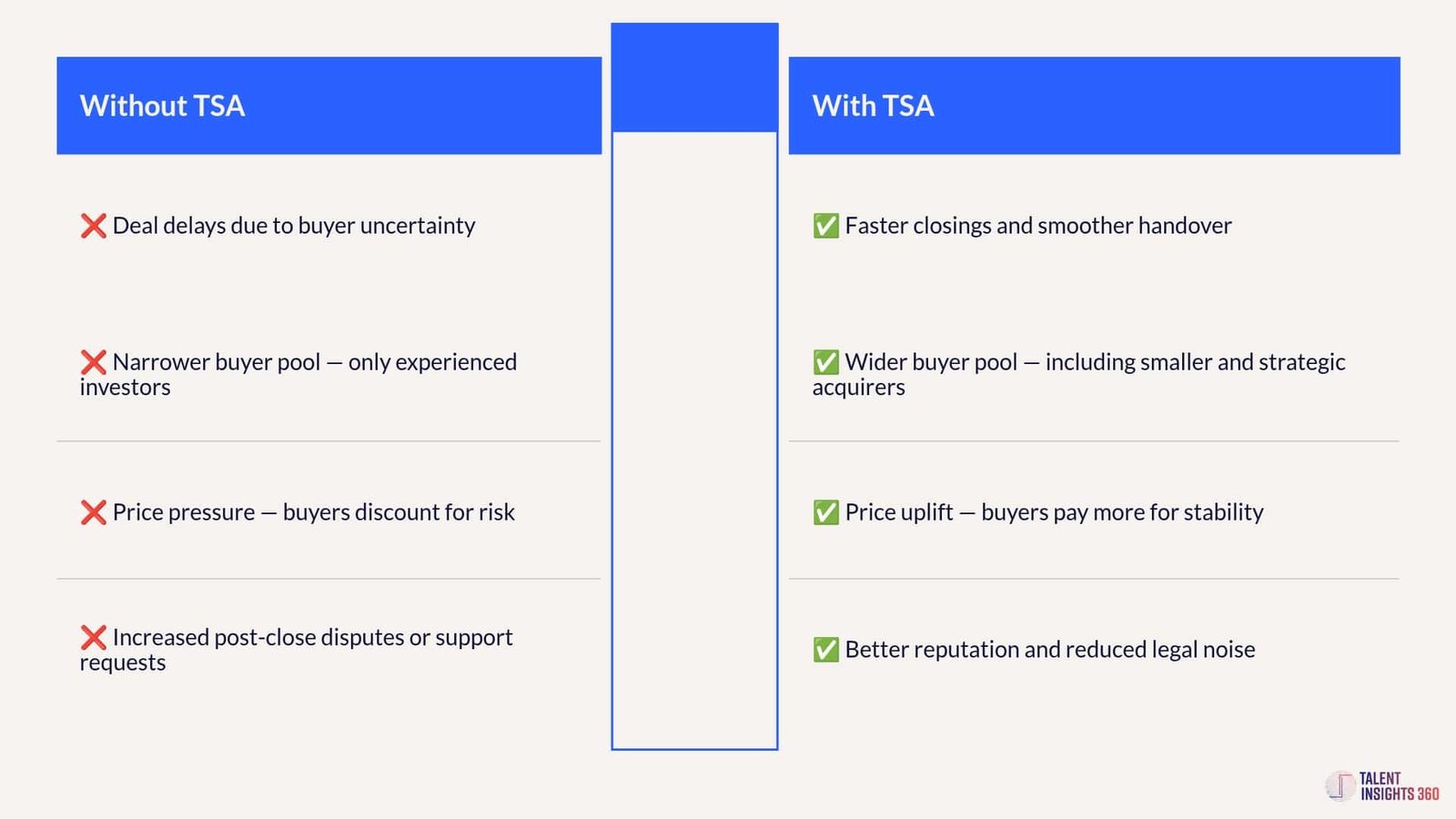
A well-scoped TSA doesn’t need to be open-ended or burdensome. It can be short-term, precisely defined, and priced accordingly. What it does is offer the buyer a bridge — and in doing so, it increases trust, speed, and valuation.
De-Risking the Deal Starts Before the Deal
The best time for sellers to prepare is before the buyer begins asking. A few practical steps:
- Map key dependencies: Who holds critical knowledge? Are there any single points of failure?
- Assess systems handover: Which HR/payroll/IT systems are shared? Can access be transferred or continued temporarily?
- Identify cultural or leadership risks: Are there retention concerns? Would a sudden departure create instability?
- Design a lean TSA playbook: Offer clarity — what services can be provided, for how long, and at what cost?
This level of preparation answers questions before they become objections.
It transforms the seller’s position: not just someone offloading an asset, but a partner presenting a de-risked, investment-ready opportunity.
Why It Matters More Than Ever
In today’s environment — with more deals competing for fewer premium buyers — sellers need every advantage.
A well-prepared seller:
- Attracts a broader buyer pool
- Accelerates deal execution
- Strengthens valuation position
- Reduces post-close headaches
And it starts by treating human capital not as noise, but as a signal.
The Takeaway
If you’re preparing for a sale, human capital should be part of your deal preparation, not just a response to due diligence.
When sellers own this readiness, they don’t just protect value — they create it.
And if at some point, you decide to bring in specialists to help structure this layer — to design the TSA, map the risks, and support the transition — there are experts who do just that.
But first, it begins with the choice to see this issue — and to prepare with intent.